The Motion-Control Behind Ed Sheeran’s ONE SHOT Bus Sequence
There’s something undeniably electric about a one-shot sequence. When everything unfolds in real time — the movement, the performance, the choreography — there’s no cutting away, no second chance. Just pure coordination.
Ed Sheeran’s recent “ONE SHOT” project for Netflix captures that feeling at full scale: a one-hour continuous take performed live while moving through multiple locations in New York City. A moving bus, handheld operators weaving through tight spaces, technocranes, a drone, lighting cues, and more than 400 crew members all coordinating in sync.
Within that massive operation, motion control played a small but essential supporting role.
A One-Take Concept With Moving Parts Everywhere
Directed by Philip Barantini — known for Boiling Point, Adolescence, and his signature single-take approach — the shoot hinged on fluidity and timing. The camera had to move with intention, matching the pace of the performers and choreography without ever breaking the illusion of a continuous moment.
One of the most technically demanding segments was the exterior bus shot — a moment that required a controlled, repeatable camera move from a platform that was anything but stable: the roof of a moving vehicle.
This is the kind of environment where robotics becomes more than a specialty tool.
It becomes a stabilizing force within an unpredictable setting.
Motion-Control on a Moving Bus
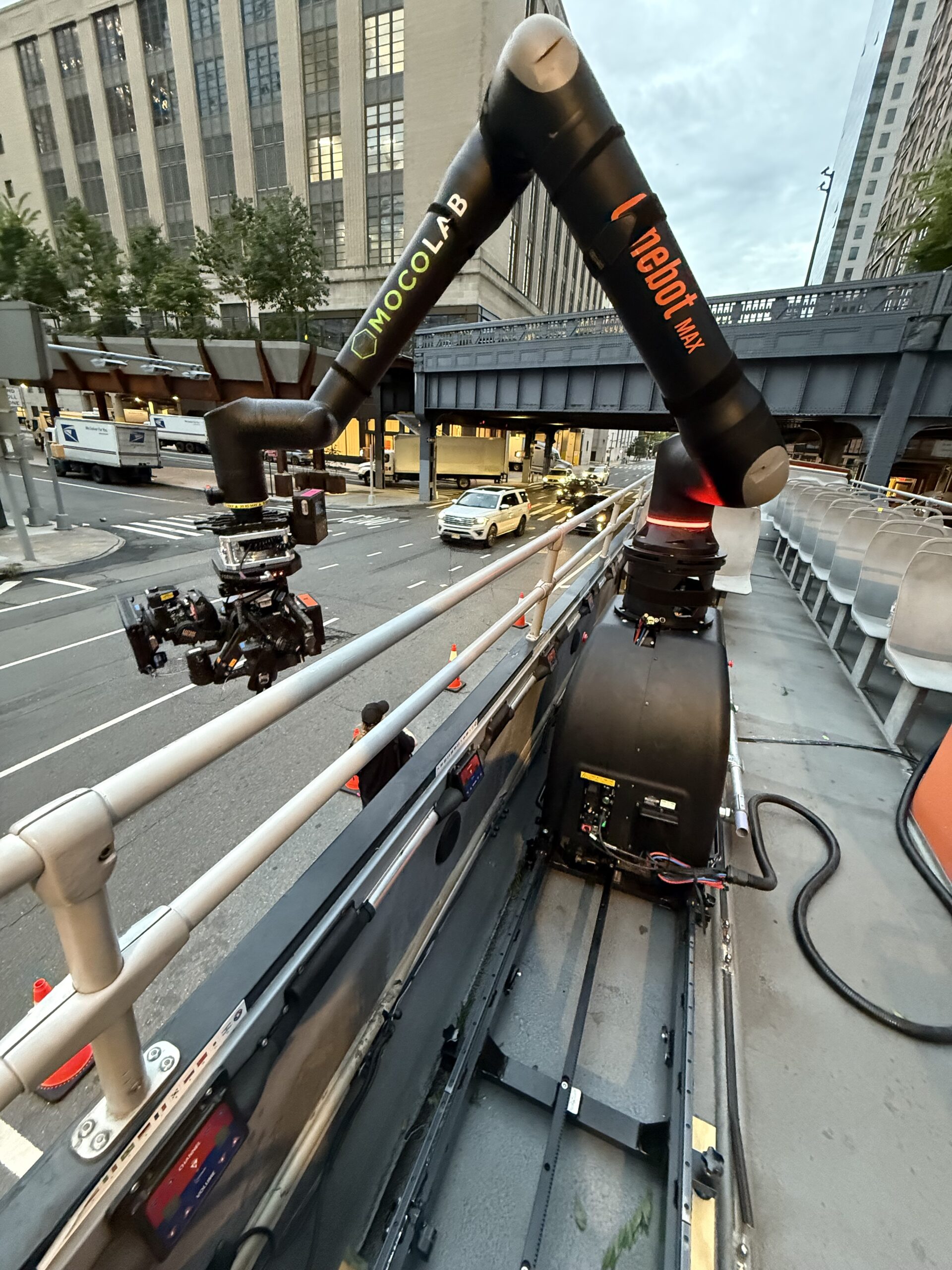
For this sequence, the production used the MRMC Cinebot Max, mounted directly to the roof of the bus using a custom electro-magnetic system designed by Director of Photography Nyk Allen.
Mocolab, Expressway’s motion-control division, supported the project by providing and operating the robot for the bus segment. The robot was operated by Josh Treadaway,, with technical support from Mike Greenberg, working in tandem to align precise robotic movement with the timing of the performance and the choreography happening inside and around the vehicle.
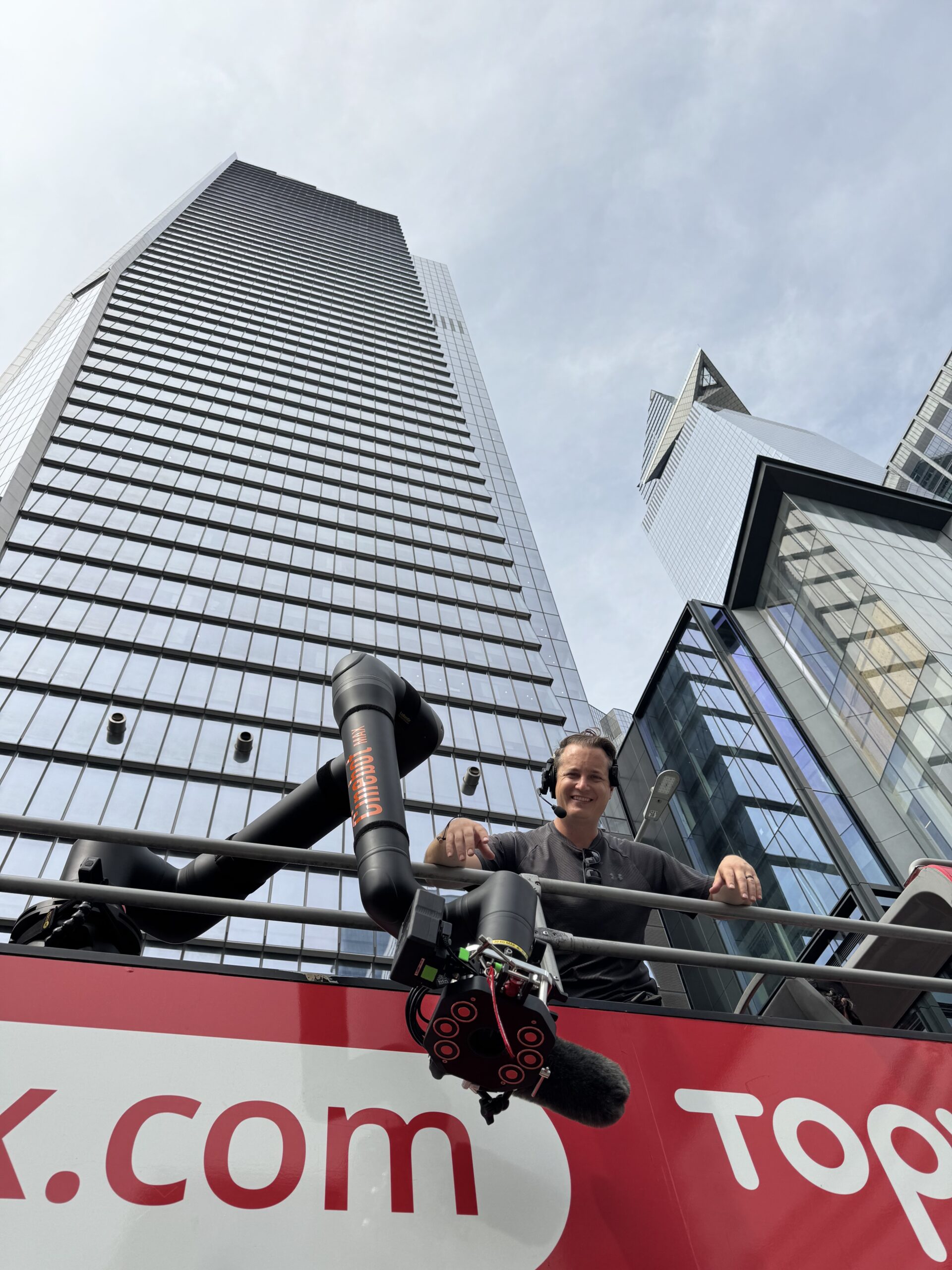
Their role focused on reliability and repeatability — delivering stable, consistent motion while handheld units, cranes, drones, and performers flowed around the moving bus. In a one-hour continuous take, that dependability is essential.
Where Stabilization Meets Robotics
Alongside the motion-control work, the production also made use of the DJI Ronin 4D (not provided by Expressway), which offered its own take on stabilization and mobility during interior and ground-level portions of the sequence.
From the camera team’s perspective, this project introduced an entirely new layer of complexity. Longtime Expressway collaborator Ryan Baldwin, who served as a 2nd Camera Assistant on the shoot, shared that the Ronin 4D was still a relatively new tool for much of the camera team.
“We faced a lot of challenges on this one — both technical and logistical — and never quite had enough time,” Ryan told us. “We had one day of prep for two camera bodies, five days to rehearse each segment of the shot, and two days with Ed to actually capture it.”
Multiple identical Ronin 4D builds were prepared in parallel: one main camera, one backup, and additional units sent out for testing with different departments. The final take ultimately used a different body than originally planned — a reminder of how fluid even the most carefully prepared systems had to be.
Camera Operator Joe Blodgett, one of four operators on the project, described the constant transitions required throughout the take. Operators were frequently navigating fluid choreography while moving the camera between handheld operation, technocranes, robotic arms, and drone handoffs — all without breaking the illusion of a single continuous shot.
“This shot would’ve been impossible on any other rig,” Joe told us. “But it does come with its challenges. When switching between handholding the camera and cranes, you had to disengage the 4D axis and switch the gimbal head mode to lock. That gave full control to the wheels operator so the camera wouldn’t fight the crane movement — and all of that had to happen while still operating the shot.”
Pass-offs between operators, attaching and detaching from cranes, grabbing the camera from the drone — those connection points had to be imperceptible. Add in wireless video latency, focus control, power management, and constantly shifting blocking, and every transition had to feel invisible.
Every decision had to be right the first time.
What made it work wasn’t any single tool — it was the orchestration between them.
The combination of a full-scale Cinebot Max and a modular stabilized platform like the Ronin 4D reflects a broader truth in modern cinematography:
Precision comes from systems — and from the people who know how to blend them.
If you’d like to explore the Ronin 4D in more depth, here’s our recent Expressway breakdown of the system:
https://blog.expresswaycine.com/dji-ronin-4d-8k-rental-expressway/
Behind the Scenes
For anyone who loves seeing how these sequences come together, the BTS footage from this shoot offers a great look at the robot rigging, the mounting system, and the controlled chaos surrounding the bus unit:
MRMC has also published a detailed case study on the robotics side of the project here:
→ https://www.mrmoco.com/case-studies/ed-sheeran-one-shot-one-hour-one-robot/
Why Shots Like This Matter
A one-shot sequence is never just a technical exercise. It’s a trust exercise — between departments, between tools, between the hundreds of people responsible for each moment.
Every move affects the next. Every beat depends on the one before it.
When it works, it feels effortless on screen — even though it’s anything but effortless behind the scenes.
Projects like this are a reminder of how collaboration, engineering, and timing intersect to create cinematic moments that resonate. Whether it’s a handheld operator threading through a crowded bus or a motion-control robot holding a perfectly stable frame on a moving vehicle, each element contributes to the story in its own way.
We’re always proud to support productions pushing this level of ambition — in whatever role we’re asked to play.
Contact Us.
Written By: Jhania Perez –
By day she runs Expressway’s marketing machine, by night (and let’s be honest, also by day), she’s a full-time dog mom.