Why the Canon 518 SV Still Finds Its Way Onto Professional Sets
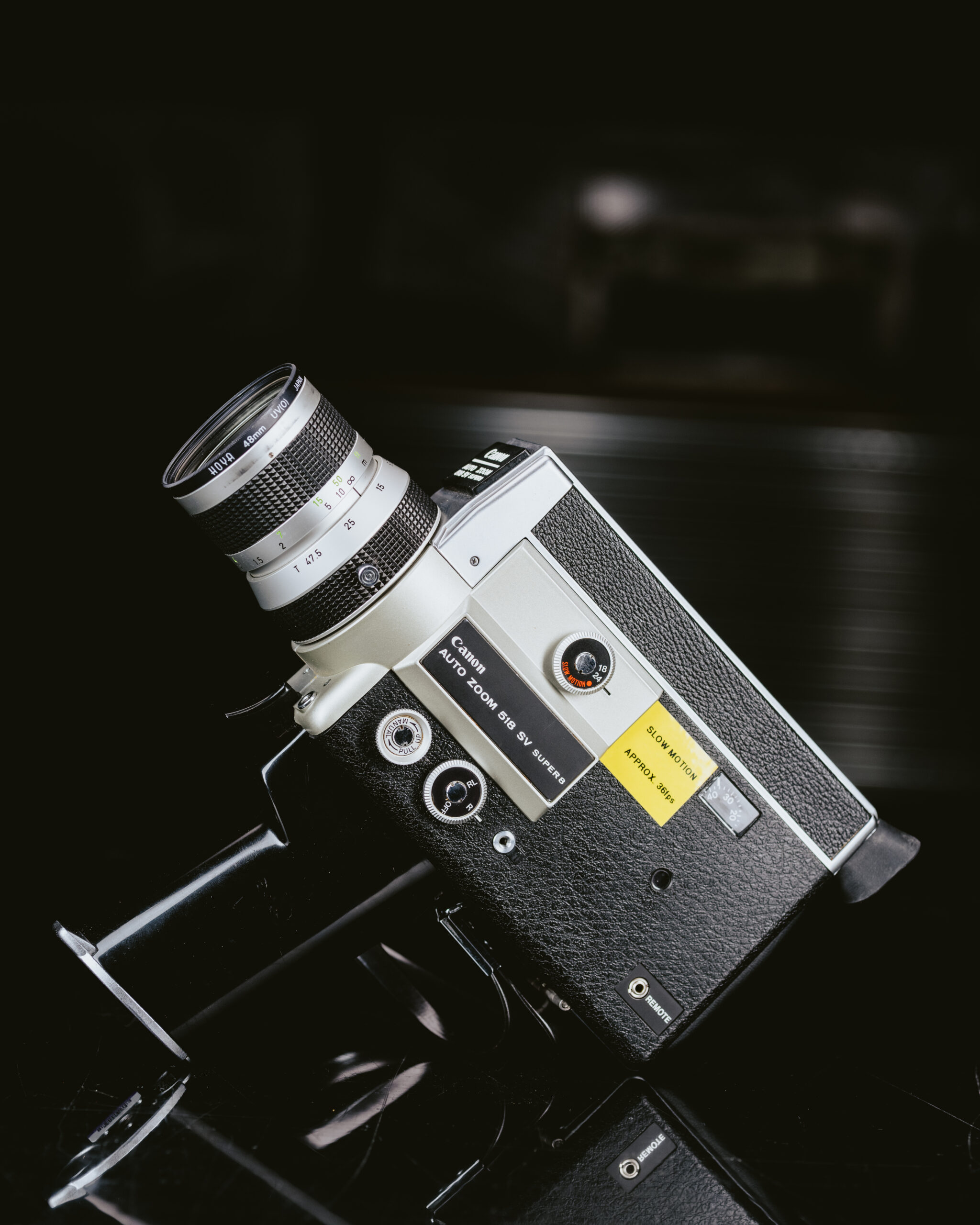
The Canon 518 SV wasn’t designed to become a specialty camera.
When Canon introduced it in 1971, the goal was straightforward: make Super 8 filmmaking easier and more reliable for a growing market of independent filmmakers, students, documentarians, and home moviemakers.
Features Include:
- Automatic exposure
- Fast f/1.8 powered zoom lens
- 36fps Slow Motion option
- Kodak’s simple cartridge-based film system
More than five decades later, the Canon 518 SV Super 8 camera is still being loaded with fresh film.
Today, it continues to show up on commercial productions, music videos, documentaries, and narrative projects where filmmakers are looking for ways to add character and nostalgia that originate during image capture rather than being recreated in post.

A Camera Built Around the Format
The conversation around Super 8 often focuses on aesthetics – the grain, the color rendition, or the softer contrast associated with reversal and negative stocks.
Those qualities certainly contribute to its appeal, but they aren’t what changes the shooting experience.
A standard 50-foot Super 8 cartridge runs for roughly three minutes at 18 frames per second. That limitation influences coverage from the moment the camera starts rolling. Takes become shorter, setups become more deliberate, and operators tend to spend more time evaluating a composition before exposing film.
It’s a workflow that’s fundamentally different from modern digital acquisition, where recording time is measured in hours rather than minutes.
The Canon 518 SV’s Place Today
Digital emulation has become remarkably convincing. Grain overlays, halation plugins, gate weave simulations, and film print LUTs can reproduce many of the visual characteristics associated with analog acquisition.
Yet productions continue to reach for actual Super 8 film – even on the large budget commercial work looking to introduce some texture and style.
Part of that decision is aesthetic, but another part is practical. Film responds to highlights differently. Grain is inherent to the emulsion rather than added later. Small variations in transport, exposure, and processing introduce subtle inconsistencies that are nearly impossible to duplicate exactly from one shot to the next.
For projects built around memory, archival storytelling, documentary work, or emotionally subjective sequences, those characteristics often become part of the visual language rather than imperfections to correct.
The Canon 518 SV’s Place Today
The Canon 518 SV Super 8 camera remains one of the more approachable Super 8 cameras to operate.
Its automatic exposure system allows for flexibility in changing environments, while the fast Canon zoom lens makes it versatile for handheld work as well as allows for nostalgic zoom rack sequences for B-Roll. For productions where the camera will be used to quickly pick off shots or the director wants to operate, its straightforward operation enables it to be an easy set-and-forget camera.
It fills a niche that digital workflows still struggle to replicate: an image shaped not only by optics and lighting, but by the physical characteristics of film itself.
Why We Continue to Stock It
Most rental houses are focused on keeping pace with the latest camera systems, and so are we.
The Canon 518 SV has earned its place through decades of use and we chose it specifically for its ease-of-use and reliable operation. It’s a great addition to intersplice alongside digital footage, as well as an easy tool for creatives on set that are not camera professionals. And if it’s the right fit for your next shoot, we’ll make sure it’s ready when you are.
Written By: Jhania Perez –

By day she runs Expressway’s marketing machine, by night (and let’s be honest, also by day), she’s a full-time dog mom.